
If you are applying for an EB-1A (Extraordinary Ability) or a National Interest Waiver (NIW), you are not just preparing documents. You are entering a legal system that has been shaped by important court decisions over many years.
These cases were fought by real applicants who challenged unfair denials. Because of them, USCIS cannot freely change rules, ignore evidence, or apply unreasonable standards.
Understanding these cases will help you:
- Build a stronger petition
- Avoid common mistakes
- Recognize unfair decisions
- Work better with your attorney
Below are the most important cases, explained in simple language, along with links to official sources.
1. INS v. Cardoza-Fonseca (1987) — USCIS Cannot Invent New Standards
This U.S. Supreme Court case established a very important principle: immigration agencies must follow the law as written by Congress.
You can read the official summary here:
Read official case summary (Cornell Law)
The Court explained that agencies cannot apply stricter standards than what the law requires. (Legal Information Institute)
Why this matters for EB-1A and NIW:
- USCIS officers sometimes add extra expectations.
- This case gives you a legal basis to challenge that.
In simple terms, if something is not written in the law, USCIS should not demand it.
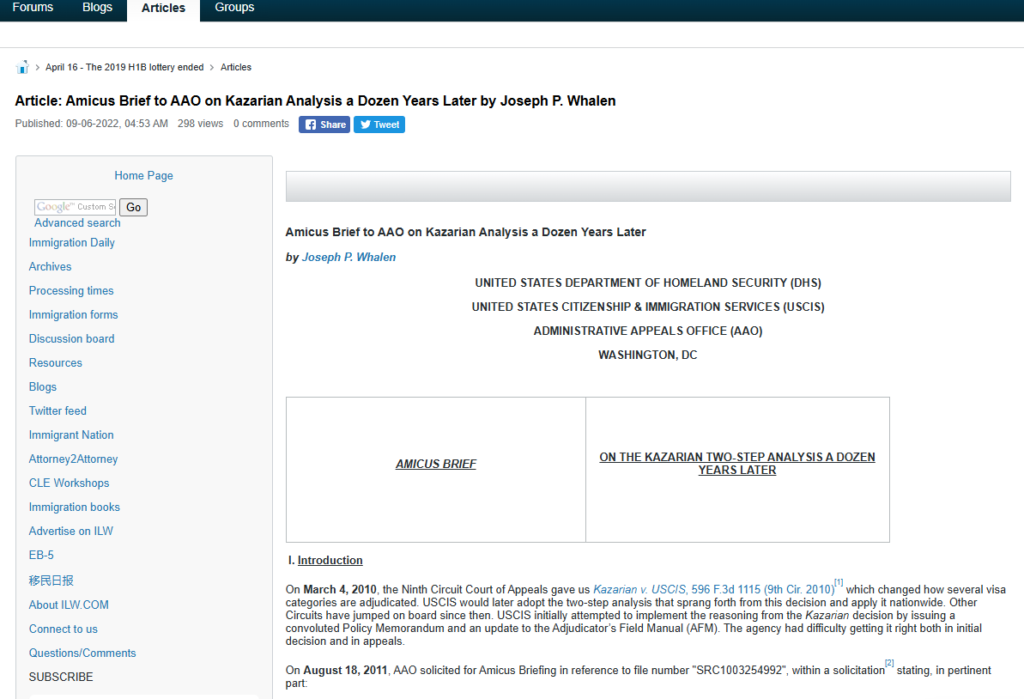
2. Kazarian v. USCIS (2010) — The Two-Step Evaluation Rule
This case changed how EB-1A petitions are reviewed.
Official background:
Read case overview
The court required USCIS to follow a two-step process:
Step one: Check whether you meet at least 3 out of 10 criteria
Step two: Evaluate your overall profile
This structure became official USCIS policy. (Wikipedia)
Why this matters:
- Officers cannot judge the quality of evidence at Step One
- They must first accept whether the evidence qualifies
If USCIS mixes these steps, the decision can be challenged.
3. Rijal v. USCIS (2011) — Expert Letters Must Be Taken Seriously
In many cases, USCIS used to ignore recommendation letters from experts.
The court ruled that:
- Expert opinions are valid evidence
- USCIS cannot dismiss them without proper explanation
Why this matters:
- Strong letters from professors or industry experts are powerful
- Especially important for researchers and NIW applicants
This case helps ensure your expert letters are given real weight.
4. Noroozi v. Napolitano — Future Impact Cannot Be Ignored
Official case reference:
View case details (vLex)
This case addressed a common problem: USCIS denying applications because the applicant’s work had not yet created large-scale impact.
The court made it clear:
- Future impact must be considered.
- Applicants cannot be penalized for being early in their field.
Why this matters:
- Many NIW cases are based on future benefit
- Innovation often takes time
This decision protects applicants working on emerging or long-term research.
5. Matter of Dhanasar (2016) — The NIW Framework
This is the most important case for NIW.
Official AAO decision:
Read official Dhanasar decision (DOJ)
It created a clear 3-part test:
- Your work has substantial merit and national importance
- You are well-positioned to advance that work
- It benefits the U.S. to waive the job offer requirement
Why this matters:
- Before this case, NIW was unclear and inconsistent
- Now there is a clear structure
Every strong NIW petition today is built around this framework.
6. Amin v. Mayorkas (2023) — USCIS Cannot Keep Raising the Bar
This case addressed a common frustration.
USCIS often:
- Accepts that you meet criteria
- Then still denies by asking for more
The court said this is not acceptable.
Key idea:
- Meeting the requirements must actually count
- USCIS cannot create “moving goalposts”
Why this matters:
- Protects applicants from unfair denials
- Reinforces that rules must be consistent
7. Mukherji v. Miller (2026) — A Major Turning Point
This is one of the most important recent EB-1A decisions.
In this case:
- The applicant met more than the required criteria
- USCIS still denied using “final merits” reasoning
The court strongly criticized USCIS and found:
- It created extra rules without proper legal process
- It applied overly subjective standards
Most importantly:
- The court ordered USCIS to approve the case directly
Why this matters:
- Courts are now actively limiting USCIS discretion
- Strong cases should not be denied arbitrarily
What These Cases Mean for You
When you look at all these decisions together, a clear pattern emerges.
For years, USCIS has sometimes:
- Added extra requirements
- Applied inconsistent standards
- Ignored strong evidence
Courts have responded by:
- Enforcing the law strictly
- Protecting applicants’ rights
- Demanding fair and consistent decisions
Final Takeaway
If you are applying for EB-1A or NIW, you should understand this:
- The law is more favorable than many people think
- Strong cases can be defended effectively
- Unfair denials can be challenged successfully
A strong petition is not just about documents. It is about:
- Presenting evidence correctly
- Using the right legal framework
- Understanding how USCIS must evaluate your case
The real advantage comes when your petition is built with these legal principles in mind.
