
Introduction
For many internationally based professionals, the idea of pursuing a U.S. Green Card while still living and working in their home country can seem paradoxical, even impractical. The common assumption is that permanent residency requires a physical foothold in the United States, an American employer willing to sponsor you, or years spent navigating the bureaucratic maze from within U.S. borders. In reality, none of that is required for the EB-2 National Interest Waiver.
The EB-2 NIW is, in many ways, the most intellectually honest immigration pathway the U.S. offers to high-skilled professionals. It asks not whether you have an employer vouching for you, but whether your work, your expertise, and your professional trajectory are genuinely valuable to the United States. If the answer is yes, you may self-petition for a U.S. Green Card from virtually anywhere in the world.
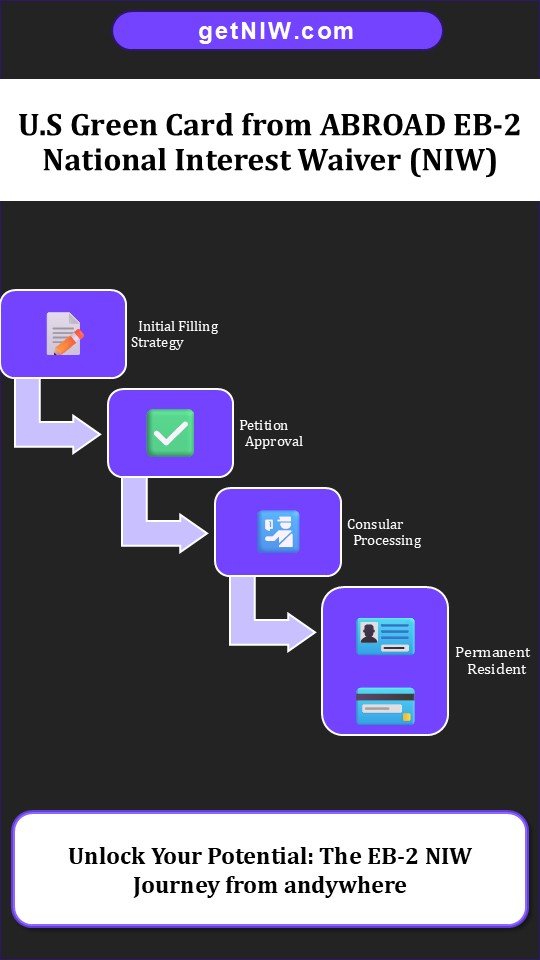
That said, applying from outside the United States introduces a distinct administrative phase: Consular Processing. While the foundational petition is identical to what a U.S.-based applicant files, the pathway diverges significantly after approval. Instead of filing for Adjustment of Status (Form I-485) within the country, overseas applicants route their case through the U.S. Department of State, culminating in an interview at a U.S. Embassy or Consulate in their country of residence.
Understanding this process in full is not optional, it is essential. Missteps in Consular Processing are harder to recover from than errors in the domestic Adjustment of Status route. A USCIS decision can often be appealed; a consular officer’s denial cannot. The stakes are real, and so is the opportunity.
This article walks you through every stage of the overseas NIW application: from your initial filing strategy to your embassy interview and first entry into the United States as a Lawful Permanent Resident.
Time-Sensitive Update: The January 2026 Immigrant Visa Pause
As of February 14, 2026, this section contains information that is directly relevant to overseas professionals currently in or approaching the Consular Processing phase.
On January 14, 2026, the Trump administration announced it is suspending immigrant visa processing for 75 countries, with the pause taking effect on January 21. The State Department framed the move as part of a broader effort to restrict entry to those deemed likely to become reliant on public assistance, citing “public charge” concerns. The affected countries include Afghanistan, Albania, Algeria, Armenia, Azerbaijan, Bangladesh, Brazil, Cambodia, Colombia, Cuba, Egypt, Ethiopia, Ghana, Haiti, Iran, Iraq, Jamaica, Jordan, Kazakhstan, Lebanon, Morocco, Nepal, Nigeria, Pakistan, Russia, Somalia, and dozens more, spanning Africa, Asia, the Middle East, and Latin America.
The pause is described as indefinite. The U.S. government has not indicated any deadline for when the suspension might be lifted, though nationals of affected countries may still submit immigrant visa applications — no immigrant visas will be approved or issued while the pause is in place. The policy is already being challenged in federal court. A group of civil rights organizations and U.S. citizens filed a lawsuit arguing the suspension attempts to “eviscerate decades of settled immigration law,” with legal experts contending that a blanket, country-wide pause fails to conduct the individualized public charge assessments required by statute.
What this means for EB-2 NIW applicants — and what it does not mean.
If you are an overseas professional currently building your NIW profile, preparing your I-140 petition, or waiting for your priority date to become current, there is an important and clarifying distinction to understand: this policy is a Department of State directive, not a USCIS policy. It specifically governs operations at embassies and consulates abroad and does not affect any applications handled internally by USCIS. Filing and adjudication of I-140 petitions continue as normal, regardless of nationality.
In practical terms, the pause touches only the very end of the immigrant visa pipeline — the consular interview and visa issuance stage. For professionals pursuing an EB-2 NIW, EB-2 NIW petitions continue to be filed, adjudicated, and approved by USCIS under existing law. There has been no change to eligibility standards, filing procedures, or approval authority. The stage affected by this pause is typically far in the future for new EB-2 NIW applicants, as due to visa bulletin backlogs, many cases filed today will not approach immigrant visa issuance for well over 20 months, often longer depending on country of chargeability.
There is also a critical structural reason why EB-2 NIW applicants are comparatively less exposed to the public charge rationale driving this pause. Employment-based categories such as EB-1, EB-2, and EB-5 are evaluated differently from family-based petitions. The law already presumes that applicants in these categories are not likely to become a public charge because the cases are grounded in professional achievement, future earning capacity, and economic contribution. An EB-2 NIW applicant, by definition, must demonstrate that their work benefits the United States in a meaningful and sustained way — a profile categorically distinct from the public charge concerns driving this suspension.
Additionally, if you are already in the U.S. on a valid nonimmigrant visa (H-1B, L-1, F-1, etc.) and have an approved I-140 petition with a current priority date, you may be eligible to file Form I-485 to adjust status domestically, which bypasses consular processing entirely.
The bottom line for serious NIW candidates is this: do not let this policy pause your petition preparation or delay your filing. Delaying the start of an immigration process rarely improves outcomes. Priority dates continue to move slowly, demand continues to increase, and reaching the consular stage often takes years. By the time a newly filed case reaches final processing, the current administration may no longer be in office, and this pause is expressly described as temporary.
Monitor the State Department website and legal developments for updates if your case is currently in the NVC or consular phase. For all others, the strategic imperative remains unchanged: build a compelling profile and file.
Key Takeaways (1-Minute Read)
Before diving into the detail, here is the essential map of what lies ahead for overseas NIW applicants:
- You do not need to be physically present in the U.S., nor do you need a U.S. employer, to file an EB-2 NIW petition.
- The process has two distinct stages: first, your petition is adjudicated by USCIS; second, your immigrant visa is processed through the U.S. Department of State via Consular Processing.
- After your I-140 is approved, you must wait for your Priority Date to become current on the monthly Visa Bulletin before advancing to the consular stage.
- The January 2026 immigrant visa pause for 75 countries affects only the consular stage. USCIS continues to accept, review, and approve I-140 petitions without interruption.
- If your application includes family members, the principal petitioner must enter the United States before or at the same time as any derivative applicants.
- Paying USCIS fees from abroad requires planning. The agency does not accept Western Union or PayPal, and many overseas applicants use U.S. credit cards or Wise multi-currency accounts to generate valid payments.
Terms Used in This Article
A brief glossary for readers new to employment-based immigration terminology:
I-140 — The “Immigrant Petition for Alien Workers,” the foundational USCIS form that establishes your eligibility for the NIW category. This is your self-petition.
Consular Processing (CP) — The method by which applicants outside the U.S. complete the second stage of the green card process, involving the National Visa Center and a U.S. Embassy or Consulate.
NVC (National Visa Center) — A Department of State processing hub that acts as the administrative bridge between your USCIS approval and your embassy interview. They assign your case number, collect fees, and coordinate document submission.
DS-260 — The online Immigrant Visa Electronic Application. For overseas applicants, this is the functional equivalent of the Form I-485 filed by U.S.-based applicants.
DS-261 — The form on which you designate your agent or attorney for NVC communications.
CEAC (Consular Electronic Application Center) — The online portal where you upload your civil documents during the NVC phase.
Priority Date (PD) — Your official place in the green card queue, established on the date USCIS receives your I-140 petition. Visa numbers are issued in order of priority date, per the monthly Visa Bulletin.
Panel Physician — A medical doctor specifically authorized by the U.S. Department of State to conduct the mandatory immigration medical examination. Results are sealed and submitted directly at your consular interview.
Background: The Overseas Self-Petition and Why It Matters
The EB-2 NIW occupies a distinctive position in the U.S. employment-based immigration hierarchy. Unlike the standard EB-2 category, which requires both an employer sponsor and a completed PERM labor certification process, the NIW waives both requirements. The legal rationale, established by the landmark administrative decision Matter of Dhanasar (26 I&N Dec. 884, AAO 2016), holds that when an applicant’s work is sufficiently important to the United States, the public interest in bringing that professional to the country outweighs the procedural requirement of finding a domestic employer who cannot fill the role.
For professionals located outside the United States, this legal architecture is particularly significant. You do not need a U.S. job lined up. You do not need a sponsor. You need to make a compelling case that your proposed endeavor in the United States has substantial merit and national importance, that you are well-positioned to advance it, and that the benefits to the U.S. outweigh the standard labor market protections that PERM is designed to provide.
This means a civil engineer in Lagos, a biomedical researcher in Seoul, a policy economist in Berlin, or a software architect in Bangalore can each, in principle, initiate a U.S. permanent residency application from their home office, without stepping foot on American soil.
What changes for the overseas applicant is the second stage. Those already in the United States on a valid visa typically file for Adjustment of Status (I-485), which is processed domestically by USCIS and includes biometrics appointments, work authorization during the wait, and potential travel permits. Those abroad undergo Consular Processing, which is generally less expensive (roughly $600 per person in State Department fees versus over $1,100 per person for Adjustment of Status), but carries one critical limitation: consular officers operate with broad discretion, their decisions are final, and attorneys are not permitted inside the interview room.
Knowing this distinction before you file is not a bureaucratic detail. It shapes your strategic approach from the very first page of your I-140 petition.
How It Works: A Step-by-Step Guide to the Overseas NIW Process
The journey from initial filing to lawful permanent residency unfolds across two major institutional phases and eight operational steps.
Phase One: USCIS Adjudication
Step 1 — File Form I-140 with Consular Processing designated
Your petition package is submitted to the appropriate USCIS Lockbox facility. On Part 4 of the I-140, you must indicate that you intend to complete your case via Consular Processing rather than Adjustment of Status. This single designation routes your approved petition to the Department of State rather than back to USCIS for the I-485 stage.
One practical note: USCIS requires a U.S. mailing address to issue physical receipt notices. Many overseas applicants use the address of a trusted friend or relative in the United States. This is entirely acceptable, though you should communicate clearly with that contact so they can forward any physical correspondence promptly.
Step 2 — Wait for I-140 Adjudication
Standard processing for an I-140 NIW petition has historically ranged between roughly ten and sixteen months, though this timeline has been compressing in recent years, with some applicants reporting adjudication in as few as three to four months. For those who cannot afford uncertainty in their planning, Premium Processing (Form I-907) is available for an additional fee, reducing the decision timeline to 45 business days. Premium Processing applies only to the I-140 stage. It does not accelerate the visa bulletin wait or the consular phase that follows.
Phase Two: National Visa Center and Consular Processing
Once your I-140 is approved, USCIS forwards your file to the NVC. What happens next depends on whether your Priority Date is already current on the Visa Bulletin for your country of birth and visa category.
If your date is current, the NVC moves quickly. If you are born in a country with significant backlogs, such as India or China, you may wait years before the NVC activates your case. During this waiting period, your approved I-140 is preserved, your priority date is protected, and you continue life abroad. Many applicants in this situation use the waiting period strategically, strengthening their professional profile or exploring whether a future EB-1A (Extraordinary Ability) petition might offer a faster path.
Step 3 — NVC Notification and Fee Payment
When your priority date becomes current, the NVC contacts you (typically by email), assigns your case a unique number, and instructs you to pay the immigrant visa application fee and the Affidavit of Support fee. These fees total approximately $600 per applicant and must be paid through the CEAC portal.
Step 4 — Complete Form DS-261 and Form DS-260
DS-261 designates your authorized agent or attorney for NVC correspondence. DS-260 is the comprehensive online visa application covering your biographical data, employment history, travel history, family members, and questions on grounds of inadmissibility. The DS-260 is exhaustive and should be completed carefully. For NIW applicants, this form is not just an administrative exercise; it is part of your permanent immigration record.
Step 5 — Upload Civil Documents to the CEAC Portal
The NVC requires color scans of the following for each applicant in your petition: a valid passport, birth certificate, police certificates from every country where you have lived for six months or more, marriage certificate (if applicable), and any prior immigration documents. Files must generally be under 2MB each. All documents in a language other than English must be accompanied by a certified translation.
Police certificates from certain countries can require months to obtain. China, for instance, has a well-documented process for issuing police clearance letters that can add significant time to your timeline. Building this step into your planning early, even before your priority date becomes current, is one of the most underappreciated time-saving strategies available to overseas applicants.
Step 6 — Medical Examination
Before your interview, you must visit a Panel Physician authorized by the State Department in your country. This is not your personal physician; it must be a designated clinic. The physician conducts a physical examination, reviews vaccination records, and screens for certain communicable diseases. You receive the results in a sealed envelope. Do not open it. You bring the sealed envelope to your consular interview.
Step 7 — The Consular Interview
You will receive your interview appointment from NVC or the embassy. Attend on time, bring the sealed medical envelope, originals of all documents you uploaded to CEAC, two passport-style photographs, your appointment confirmation, and your DS-260 confirmation page. All family members included in your petition should attend together.
The interview itself is often less intense than applicants expect. Consular officers for NIW cases typically ask a focused set of questions about your professional background, your intended work in the United States, and your personal circumstances. The substantive legal analysis was conducted by USCIS when your I-140 was approved; the consular officer is primarily verifying your identity, confirming your civil documents, and checking for any grounds of inadmissibility. That said, the outcome is final. There is no administrative appeal mechanism if your visa is denied at this stage.
Step 8 — Visa Stamp, USCIS Immigrant Fee, and Entry
If your interview is successful, the consular officer will retain your passport for visa stamping. Once returned, your passport will contain an immigrant visa, which authorizes you to enter the United States as a Lawful Permanent Resident. Before or shortly after entry, you must pay the USCIS Immigrant Fee ($220 per person as of recent guidance), which covers the production of your physical Green Card. You may pay this before you travel or after arrival, though paying before entry expedites card production.
A critical rule governs the entry sequence: the principal applicant, the person who filed the I-140, must enter the United States before or simultaneously with any derivative family members. This is not a technicality to overlook.
Common Mistakes and What to Do Instead
The overseas NIW pathway has predictable friction points. Understanding them in advance is a significant strategic advantage.
The U.S. address gap. USCIS mails physical receipt notices to U.S. addresses only. Applicants abroad who do not have a U.S. contact may miss important correspondence. Identify a trusted U.S. address before you file, inform that contact, and track confirmation numbers electronically through the USCIS website.
Fee payment mechanics. USCIS does not accept international wire transfers, Western Union, or PayPal. Acceptable methods include U.S. money orders, U.S. credit cards, or personal checks drawn on U.S. bank accounts. For applicants without a U.S. bank account, a Wise multi-currency account can be used to generate a valid U.S. check. This is not a workaround; it is a recognized practical solution among applicants abroad.
Underestimating police certificate timelines. The requirement to obtain police clearance from every country where you have resided for six months or more often catches applicants off guard. If you have lived in multiple countries or in a country known for slow civil document issuance, begin this process early, ideally while your I-140 is still pending.
Writing too modestly. This is perhaps the most consequential mistake overseas professionals make. The NIW standard requires you to demonstrate not just competence but significance. You must articulate, clearly and without false modesty, why your work matters at a national level, why your specific expertise and track record position you uniquely to advance your proposed endeavor, and why the United States benefits from your presence. Researchers who frame their case as one contribution among many, engineers who describe their work as routine, or entrepreneurs who hedge every claim about their venture’s impact frequently find their petitions returned with Requests for Evidence. Write as the expert you are, not as the applicant you fear you sound like.
Evidence and Documentation: Building a Persuasive Package
The I-140 petition for an NIW applicant is not a form. It is a legal brief, supported by evidence, making a structured argument to a USCIS officer. The skeleton of a strong petition has several non-negotiable components.
Successful applicants often submit comprehensive evidence packages. The volume is not the point; the quality and alignment of the evidence to the three-prong Dhanasar framework is what determines outcomes. That said, robust documentation across each prong is common in approved cases.
Every document submitted in a language other than English must be accompanied by a certified English translation, with the translator attesting to their competence. This applies to academic degrees, transcripts, employment letters, published papers, and any other foreign-language supporting materials.
Foreign educational credentials must generally be evaluated by a recognized credential evaluation agency such as WES (World Education Services) or IEE (International Education Evaluations) to establish that your degree is equivalent to a U.S. master’s degree or higher. This is particularly important for applicants pursuing the EB-2 advanced degree route.
In addition to credentials and professional evidence, overseas applicants are expected to provide a detailed professional statement or, in the case of entrepreneurs and business professionals, a substantive business plan. This document should explain specifically what you intend to do once you arrive in the United States, how it connects to the national importance claimed in your petition, and what concrete impact is expected. Vagueness here is not modesty; it is a gap in your evidentiary record.
Recent Standards: What Changed in January 2025
USCIS published updated policy guidance effective January 15, 2025, that carries meaningful implications for overseas applicants structuring their NIW petitions.
The guidance clarified that any claimed “Exceptional Ability” must be directly and demonstrably related to the applicant’s proposed endeavor. In practice, this means applicants cannot claim exceptional ability in one field while proposing to work in a substantially different domain. The connection between your background and your stated plans must be coherent and defensible.
Additionally, for applicants pursuing the EB-2 qualification route via the “Bachelor’s degree plus five years of progressive experience” provision, USCIS clarified that the five years of experience must have occurred after the degree was earned and must be within the applicant’s area of specialty. Experience accumulated before degree completion, or in unrelated fields, does not satisfy this requirement under the 2025 interpretation.
These clarifications reward careful petition architecture. Applicants whose professional trajectories are coherent, whose endeavor aligns with their documented expertise, and whose qualifications are precisely described are positioned most favorably under the current adjudication standard.
Frequently Asked Questions
Can I apply for an EB-2 NIW without a PhD?
Yes. A doctoral degree is not required. The EB-2 classification is satisfied by a U.S. master’s degree (or its foreign equivalent), or by a U.S. bachelor’s degree (or foreign equivalent) combined with at least five years of progressive, post-degree experience in the relevant specialty. There is also an “Exceptional Ability” route for applicants who can demonstrate a level of expertise significantly above what is ordinarily encountered in their field, regardless of formal credentials.
Do I need a U.S. mailing address throughout the process?
For the USCIS stage, yes. Physical receipt notices and certain correspondence are mailed to U.S. addresses. Most NVC communications after approval are handled electronically through CEAC, so the need for a U.S. address diminishes considerably after your I-140 is approved. Many applicants use a relative’s or friend’s address during the USCIS phase, which is fully permissible.
Can my spouse work in the United States after we enter on immigrant visas?
Yes. When you and your derivative family members enter the United States on your immigrant visas, you are admitted as Lawful Permanent Residents from the moment of entry. This status confers full work authorization with no restrictions on employer, industry, or location. Your Green Cards arrive by mail within a few weeks of entry.
A Final Word
The EB-2 National Interest Waiver is genuinely one of the most meritocratic immigration categories the U.S. immigration system offers. It asks whether your work has value, not whether you happen to already be in the country or have found an American company willing to sponsor you. For researchers advancing knowledge, engineers solving structural problems, clinicians serving underserved communities, or entrepreneurs building scalable solutions, the NIW offers a serious pathway grounded in professional merit rather than employment circumstance.
The current policy environment warrants attention, not panic. The January 2026 visa pause is real, its legal status is contested, and the situation will evolve. But the USCIS petition process, where your NIW case is born and its merit is judged, remains fully operational. The professionals most likely to benefit from any improvement in the policy landscape are those who have already filed, already secured an approved I-140, and are already in the queue.
Start building your case now.
References and Resources
Council on Foreign Relations: Guide to Countries on Trump’s Travel Ban List — https://www.cfr.org/articles/guide-countries-trumps-travel-ban-list
Matter of Dhanasar, 26 I&N Dec. 884 (AAO 2016) — https://www.uscis.gov/sites/default/files/err/D2%20-%20Aliens%20with%20Extraordinary%20Ability%20or%20Achievement/Decisions_Issued_in_2016/DEC192016_01D2101.pdf
USCIS Policy Manual, Volume 6, Part F, Chapter 5 — https://www.uscis.gov/policy-manual/volume-6-part-f-chapter-5
USCIS Revised NIW Eligibility Standards, effective January 15, 2025 — https://www.uscis.gov/policy-manual
U.S. Department of State: CEAC Portal and NVC Fee Schedule — https://ceac.state.gov and https://travel.state.gov/content/travel/en/us-visas/immigrate/nvc.html
USCIS I-140 Processing Time Statistics — https://egov.uscis.gov/processing-times
State Department Announcement on Immigrant Visa Pause, January 14, 2026 — https://travel.state.gov
NPR: Trump Administration Sued Over Visa Freeze on 75 Countries — https://www.npr.org/2026/02/02/nx-s1-5696686/visa-freeze-lawsuit-trump
